Chess, Checkers or Reversi: Which Strategy Game Should You Learn First?
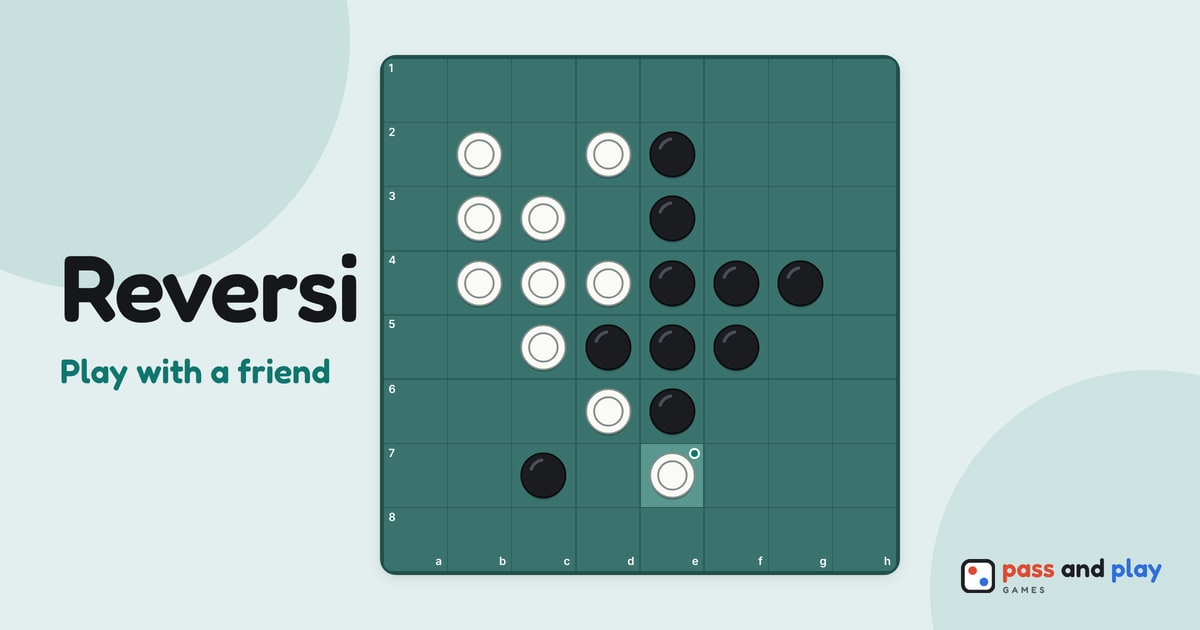
If you want a two-player strategy game to play with a partner, a friend or your kids, three classics come up again and again: chess, checkers and Reversi. All three use the same 8 by 8 board and all three reward thinking ahead. They are very different to learn and to play, though. Here is how they compare and which one to start with.
At a glance
| Chess | Checkers | Reversi | |
|---|---|---|---|
| Pieces | 16 each, six types | 12 each, one type (plus kings) | Shared two-coloured discs |
| Rules to learn | Most | Few | Fewest |
| How you win | Checkmate the king | Capture or block every piece | Most discs at the end |
| Best for | A long-term hobby | Kids and quick family games | Short games with real strategy |
Chess: the deepest, with the steepest start
Chess gives each player sixteen pieces of six different types, and each type moves in its own way. On top of that come a few special rules, such as castling, pawn promotion and en passant, plus the idea of check and checkmate. None of it is hard on its own, but there is more to take in than in the other two games.
The reward is depth. You can play chess for a lifetime and keep improving, and there is a huge amount to explore in openings, tactics and endgames once you are hooked. Games can last anywhere from ten minutes to over an hour. If you are learning, playing against a computer opponent set to an easy level is a low-pressure way to practise. The chess rules guide is a good place to start.
Checkers: quick to learn, great with kids
In checkers (called draughts in the UK) every piece starts the same. Pieces move diagonally forwards on the dark squares and capture by jumping over an opponent's piece. In the standard rules, captures are compulsory: if you can jump, you must. A piece that reaches the far side becomes a king and can move backwards too.
That is nearly the whole game, which is why children can play a real game within minutes. The forced-capture rule also adds a neat layer of strategy, because you can offer a piece to pull your opponent's pieces where you want them. You can play checkers free with forced jumps, multi-jumps and kinging handled for you.
Reversi: simple rules, surprising depth
Reversi starts with four discs in the centre of the board. On your turn you place one disc so that it traps a straight line of your opponent's discs between it and another of your discs, then flip the trapped discs to your colour. Lines can run in any of the eight directions. If you cannot trap anything, you pass. When neither player can move, whoever has more discs wins.
A game has at most 60 moves, so it rarely takes more than 10 to 20 minutes. Beginners tend to grab as many discs as possible every turn, which is usually a mistake. The key insight is that a disc in a corner can never be flipped, so the corners are the most valuable squares on the board, and the squares next to them are often dangerous to take early. Read the Reversi rules guide for the full details.
So which should you learn first?
- Playing with young children? Start with checkers. One kind of piece and a clear goal make it easy to follow.
- Want a quick game after dinner? Try Reversi. You can learn it in one game and still be finding new ideas months later.
- Looking for a long-term hobby? Go for chess. It takes longer to get comfortable, but there is no limit to how far you can take it.
You do not have to pick just one. All three are free to play on one phone, tablet or computer, so you can pass the device back and forth and try each in an evening. For more ideas, see our guide to 7 free board games to play with friends on one phone.


Comments
Post a Comment